
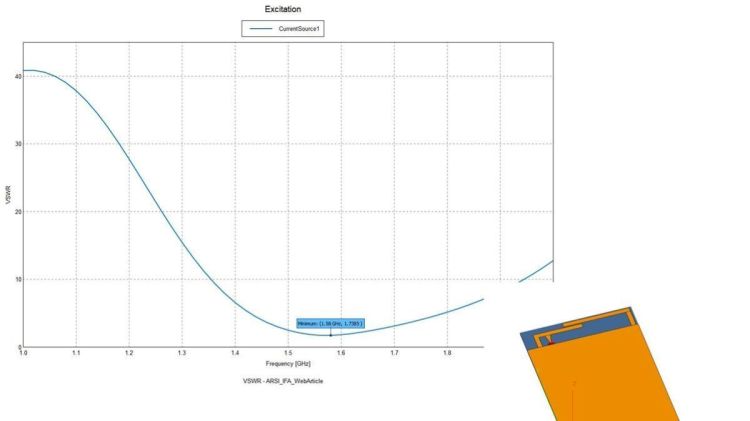
VSWR stands for Voltage Standing Wave Ratio. VSWR is an important antenna parameter. It is especially useful for transmit antennas because it is a measure of how much of the power sent to an antenna is reflected back at the transmitter.
Ideally, of course, all of the power fed to an antenna is radiated. As previously mentioned regarding antenna gain, there is always some loss in antennas, largely due to resistances in the material. However VSWR introduces another measure of loss: reflection.
The Significance of Reflected Voltage
If the impedance of an antenna does not match that of the source, there will be a reflection depending on the scope of the mismatch. Obviously, then, the antenna should be properly matched to the source (and transmission line) for the most efficient radiation.
At a glance, it may seem that VSWR is just another way of measuring loss, but there is more to it than that. The voltage reflected by the antenna must go somewhere and the “where” is the signal source. This reflected voltage is indeed real. As the transmitter is very unlikely to be designed such that large signals can be fed into its output with impunity, this reflected voltage poses a threat to the transmitter. The reflected voltage ends up being turned into heat, which can lead to the transmitter overheating or even burning out.
What VSWR Represents
So how do you know if you have a good VSWR?
VSWR is derived from (1 + p / 1 – p). The term p stands for reflection coefficient. The reflection coefficient is a decimal number that is the ratio of the voltage out versus the voltage in to whatever we are testing, in this case an antenna. The VSWR should ideally be 1, which is only possible if the reflection coefficient is 0.
Ideally, the VSWR should be kept as low as possible. In reality, there will be reflection of power, if slight.
VSWR Examples
Poor VSWR is frequently a result of mismatch, for example terminating a 50 ohm source with a 30 ohm load. However there is more to achieving a good VSWR than simply avoiding mismatches.
In the worst case, the VSWR would have a reflection coefficient of 1, where 100 percent of the voltage is reflected back to the transmitter —the reflected power ends in a dead short. If we add an attenuator between the source and the short, we suddenly have a better VSWR. In this case, less voltage is returned because some of the power is burned up at the attenuator.
Good VSWR Does Not Mean Good Radiation
While antennas with poor VSWR are not radiating as efficiently as they could, VSWR does necessarily have to have anything to do with how efficiently the antenna radiates.
A 50 ohm load has a great VSWR —but does it radiate? Adding loss in series with an antenna with a poor VSWR is one way to improve the VSWR number, although less voltage is radiated.
Adding loss in series with an antenna actually improves the VSWR more than it decreases the radiation of the antenna. The voltage going to the antenna passes through the attenuator once, while the reflected voltage must pass through it again on its way back.
Why VSWR is Important
Why is VSWR important in a well-designed antenna?
There will always be at least some mismatch. Furthermore, it is not likely that the antenna matches its source and transmission line equally at all frequencies. Also, some devices are simply more sensitive to reflected voltage.
The end result is that VSWR can be a very significant design parameter. A minimum worse case VSWR should be specified for new antenna designs where it is possible that reflected voltage can cause damage.
 ARSI
ARSI 
You must be logged in to post a comment.